
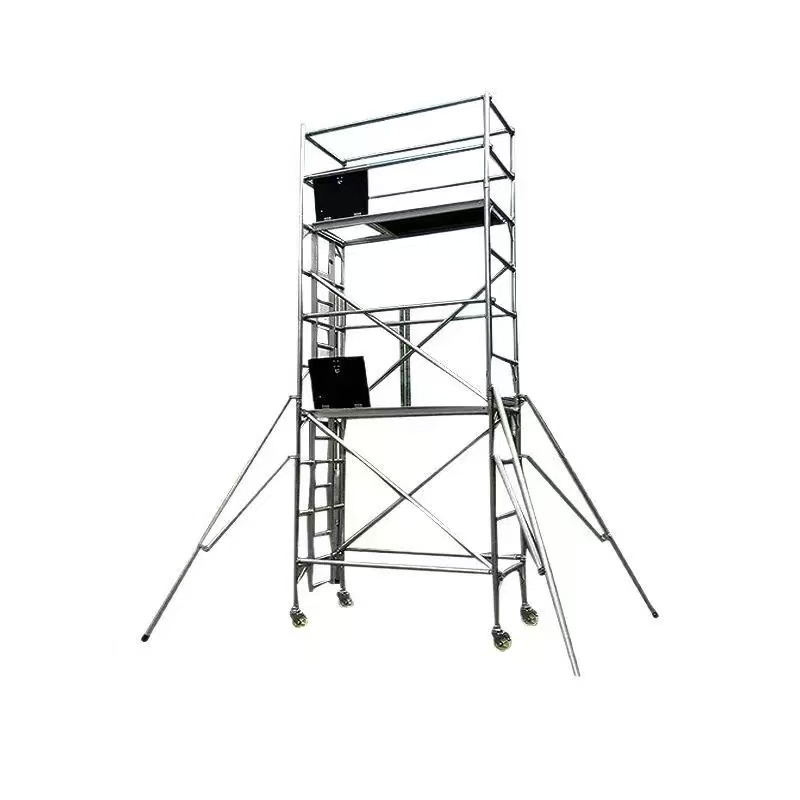
In windy areas, scaffolding acts as the temporary framework for a building. If the wind is strong and the framework is unstable, it not only affects construction but also poses safety risks. Conventional scaffolding erection methods are simply insufficient in strong winds. Therefore, in such areas, extra reinforcement measures are necessary to maximize wind resistance.Do Scaffolding Use Requires Extra Safety Measures in Cold, Snowy Regions?
First, install more connecting components between the scaffolding and the building, commonly known as wall ties. In normal areas, one tie at regular intervals is sufficient; in windy areas, the intervals should be halved, and the number doubled. These components act like “handles” for the scaffolding, firmly gripping the building structure, making it difficult for the scaffolding to bend even in strong winds. During installation, it is crucial to secure them to solid parts of the building, such as concrete beams and columns, avoiding installation on unstable areas like hollow bricks, otherwise, the reinforcement is ineffective.How to Fix Shaking and Creaking Scaffolding?
Second, ensure the scaffolding’s “feet” are firmly planted. Strong winds will cause the scaffolding to sway; if the base is not stable, the entire scaffolding may collapse. To increase the contact area with the ground, thick wooden planks or concrete blocks can be placed under the base of the scaffolding. If the ground is soft soil, it must be compacted first, or a small pit should be dug and stones buried to prevent the scaffolding from sinking or shifting. Additionally, drainage should be ensured around the foundation to prevent rainwater from softening the ground, which would make it more susceptible to wind damage.How to Conduct Daily and Weekly Routine Safety Inspections of Scaffolding
Several diagonal braces and tie rods should also be added to the scaffolding. Just as a person needs to hold onto something when unstable, scaffolding also needs diagonal support to distribute wind force. A row of diagonal braces can be installed on the outer side of the scaffolding every two layers, extending diagonally from the bottom to the top, forming a stable triangular structure—a triangle is the most sway-resistant shape. If the scaffolding is relatively high, horizontal tie rods should be installed at the top to connect the scaffolding in all directions, preventing deformation on one side due to wind.
Furthermore, the height and spacing of the scaffolding must be controlled. In areas with strong winds, scaffolding should not be erected too high. If it exceeds a certain height, it should be erected in sections, each with independent reinforcement. The spacing between horizontal and vertical poles should also be reduced. While a standard spacing might be 1.5 meters, in strong wind areas, it should be reduced to less than 1 meter to make the overall structure more compact, preventing wind from easily entering and disrupting the structure. At the same time, unnecessary debris, such as excess pipes and tools, should be removed from the scaffolding to reduce its weight and wind resistance.
Another easily overlooked point is checking the stability of all joints. Scaffolding is connected by individual couplers. Strong winds will constantly shake the scaffolding, and over time, the couplers may loosen. Therefore, after erection and after each strong wind, each coupler should be checked and tightened with a wrench. If any damaged couplers are found, such as those with cracks or deformation, they should be replaced immediately. Do not continue using them—a small problem can lead to major issues with the entire scaffolding.
Finally, if a particularly strong wind warning is issued, such as a hurricane or storm, construction must be suspended and all workers on the scaffolding evacuated. A layer of windproof netting can also be installed on the outside of the scaffolding; this reduces the impact of the wind and prevents construction materials from being blown away. However, it’s important to choose a sturdy material for the windproof netting; thin plastic sheeting will easily break in the wind and may cause the scaffolding to sway.
The key to reinforcing scaffolding in windy areas is “more connections, more bracing, and more inspections.” Don’t be lazy at any step; follow local construction standards to ensure the scaffolding remains stable in strong winds. After all, construction safety is the fastest way to achieve construction speed.