
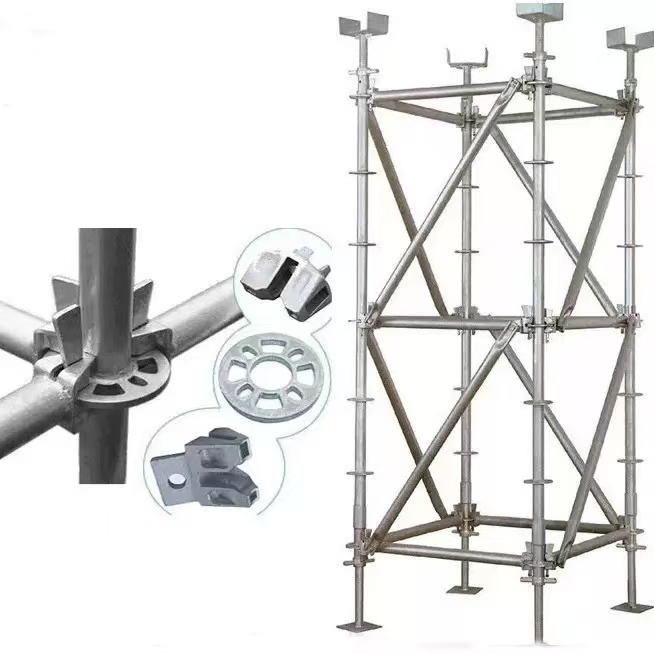
Maintaining equipment in a petrochemical plant is nothing like a regular construction site—flammable and explosive gases and highly corrosive chemical media are everywhere, and equipment is crammed together in such a cramped space that it’s difficult to move around. Erecting scaffolding in this environment isn’t just about “making sure people can stand on it”; a bunch of “special rules” must be followed, otherwise, safety red lines can easily be crossed. Today, we’ll explain in plain language the essential “life-saving requirements” that scaffolding used for petrochemical plant equipment maintenance must meet.Which type of scaffolding is safest for bridge underpass maintenance?
First and foremost, the materials must be “explosion-proof.” This is the most crucial requirement, and there can be no ambiguity. The oil fumes and chemical dust floating in a chemical plant can explode even from a tiny spark. Therefore, scaffolding absolutely cannot be made of ordinary steel; it must be made of non-sparking materials, such as aluminum alloys, copper alloys, or steel that has undergone explosion-proof treatment. Even the tools used during erection must be explosion-proof, such as brass wrenches and rubber mallets, to prevent any operation that might generate sparks. After all, in a chemical plant, “a spark is a time bomb.”Which type of scaffolding is most reliable for high-rise building exterior wall construction?
Secondly, the scaffolding must withstand corrosion, otherwise it will fall apart after a while. Chemical plants are full of corrosive media such as acids, alkalis, and solvents. Ordinary scaffolding will rust and soften within a few days. Therefore, either choose corrosion-resistant materials, such as stainless steel scaffolding, or apply special anti-corrosion treatments, such as applying thick layers of anti-corrosion paint and wrapping with anti-corrosion tape. Especially for parts that frequently come into contact with chemical media, the corrosion status must be checked regularly, and any problems must be dealt with promptly to prevent the scaffolding from becoming an “invisible killer.”How to Erect Scaffolding Inside Confined Historical Buildings
Furthermore, the type of scaffolding must be “suitable” for narrow spaces; a “one-size-fits-all” approach is not feasible. Chemical plants have numerous and densely packed equipment, and many maintenance points are hidden in the gaps between equipment, making it impossible to erect ordinary scaffolding. In such situations, flexible, small-scale scaffolding is necessary, such as folding scaffolding, attached lifting scaffolding, or custom-made irregular scaffolding. These scaffolding pieces are small, easily adjustable, and can be precisely fitted into narrow spaces between equipment, ensuring maintenance work is not delayed and avoiding contact with surrounding precision equipment.
Safety precautions are taken to the maximum extent, twice as strict as on ordinary construction sites. In addition to standard safety nets and anti-slip mats, chemical plant scaffolding requires extra protective measures. For example, combustible gas detectors are installed around the scaffolding to provide timely warnings if excessive gas levels are detected; the bottom of the scaffolding must be properly sealed to prevent chemical waste liquids and dust from falling into the equipment and causing pollution or corrosion; and explosion-proof lighting equipment must be installed to allow workers to operate in the shadows of the equipment while preventing sparks from the lighting equipment.
The erection and use procedures also have “special rules” and cannot be followed arbitrarily. Before erection, the work area must be cleared, and flammable, explosive, and corrosive materials must be removed or isolated. Erection must be carried out by certified professionals, and every connection point must be checked for security; there must be absolutely no loose connections or stripped threads. When using scaffolding, do not pile too many materials on it, especially flammable and explosive tools or materials. Workers must wear anti-static work clothes and respirators, and move with extreme care to avoid collisions that could generate sparks.
Another easily overlooked point is that scaffolding must be kept away from “hazard sources.” For example, it should not be erected directly under safety valves, sewage outlets, or material pipeline interfaces to prevent chemical leaks from directly splashing onto the scaffolding. Sufficient distance must also be maintained from high-temperature equipment and steam pipes to prevent heat-induced deformation of the scaffolding material. If the scaffolding needs to be near electrical equipment, proper insulation must be provided to prevent electric shock.
Finally, a reminder: scaffolding in chemical plants cannot be “made do”; every requirement is a matter of life and death. Whether it’s selecting materials, setting up scaffolding, or daily use, everything must be done strictly according to regulations. A thorough inspection must be conducted before starting work each day, and any problems found must be immediately stopped for rectification. After all, in a petrochemical plant, safety is always the top priority; even the slightest carelessness could lead to a major accident.