
Scaffolding erection faces two major challenges in the renovation of historical buildings: firstly, limited space, often characterized by narrow corridors, uneven floor heights, and dense beams and columns, making conventional scaffolding unsuitable; secondly, high requirements for cultural relic protection, necessitating avoidance of damage to ancient walls, wooden components, and floor decorations. Therefore, the core logic for scaffolding erection inside confined historical buildings is “lightweight, modular, and low-disruption,” requiring a customized erection plan that combines the building’s structural characteristics with cultural relic protection regulations. This article breaks down the practical process in detail, covering aspects such as preliminary preparation, core erection plan, protection points, and safety management.Price Negotiation Techniques for Scaffolding Safety Regulations Across Countries
Accurate preliminary surveying and customized plan are prerequisites for successful erection. A comprehensive survey must be conducted first: using a laser rangefinder to accurately measure the internal space dimensions (width, height, beam-column spacing), marking inaccessible cultural relic components (such as murals, carved beams and columns, and ancient brick floors); testing the building’s structural load-bearing capacity, focusing on the load-bearing capacity of ancient walls and floors to prevent scaffolding loads from exceeding structural limits. Secondly, a customized solution is developed based on the survey results: Lightweight, detachable scaffolding types are prioritized, with clearly defined erection height, span, and upright spacing. This ensures the solution meets the operational space requirements while avoiding cultural relic components, and also provides access for construction personnel and material transportation. If necessary, the solution should be reviewed jointly by cultural relic protection experts and structural engineers to ensure compliance and safety.How to Obtain Bulk Quotes for Scaffolding Systems in Large-Scale Projects
Core Erection Solutions: Three preferred models suitable for confined spaces. Firstly, aluminum alloy quick-assembly scaffolding, suitable for most confined indoor scenarios. This type of scaffolding is lightweight (weighing only 1/3 of traditional steel pipe scaffolding), with modular components that can be flexibly assembled into different sizes. It requires no large installation equipment and is suitable for operations in narrow spaces such as corridors and small halls. Key points for erection: The spacing between uprights should be controlled at 1.2-1.5 meters, and the horizontal bar spacing should not exceed 1.8 meters to ensure structural stability; the bottom should use an adjustable base with rubber anti-slip mats to avoid scratching the ancient ground and to address uneven ground conditions; if crossing beams or columns is necessary, irregularly shaped components can be used to avoid drilling holes in the cultural relic components for fixing.What Risks and Inspection Points Should Be Noted When Purchasing Used Scaffolding?
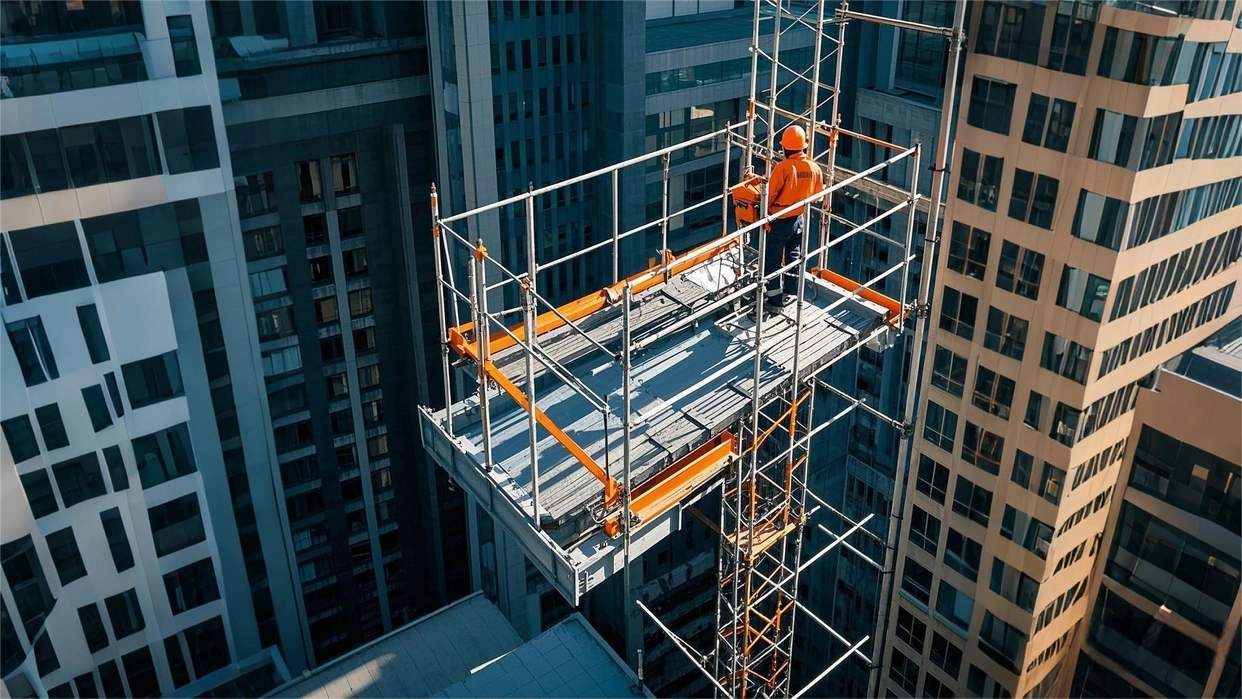
Secondly, attached lifting scaffolding is suitable for repairs in high and narrow spaces. For historical buildings with high ceilings and narrow lateral spaces (such as the interior of ancient pagodas and corridors of ancient pavilions), attached lifting scaffolding can significantly save space. This type of scaffolding is fixed to the main structure of the building using special attachment devices (prioritizing non-load-bearing components), without occupying a large area of ground space, and can be raised and lowered as construction progresses, reducing the number of disassembly and reassembly operations. Key points for erection: Attachment points must be calculated by a structural engineer, using detachable expansion bolts for fixation to avoid permanent damage to the building structure; the width of the scaffolding platform should be controlled between 0.8-1.2 meters, sufficient for single-person operation, minimizing space occupation; fall protection devices and a synchronous lifting control system should be installed to ensure construction safety.
Thirdly, miniature scaffolding combined with hanging racks is suitable for extremely narrow spaces (such as wall gaps, around carved components). For small areas inaccessible to conventional scaffolding (such as mural restoration, paint touch-up on wooden components), miniature scaffolding can be used in conjunction with hanging racks. Miniature scaffolding is 1-3 meters high and compact, allowing direct placement around the construction area; the hanging rack is bolted to the scaffolding crossbars, extending the operating platform and precisely covering the construction points. Key points for erection: The hanging rack’s load-bearing capacity should not exceed 150kg and is only for light work; parts in contact with cultural relics should be wrapped with soft protective pads (such as cotton cloth or rubber) to avoid friction damage.
Core key points for cultural relic protection: Low-disturbance management throughout the entire process. First, contact surface protection: all contact points between scaffolding and building components must be fitted with soft protective pads or isolation boards to prevent metal components from directly rubbing against ancient walls, wooden pillars, and the ground. Second, destructive fixing is prohibited: drilling or welding is forbidden on ancient walls, beams, columns, murals, and other cultural relic components; all fixings must use detachable devices. Third, protection during construction: handle components gently during erection and dismantling to avoid collisions with cultural relics; control dust and vibration during operations, using small dust removal equipment and vibration damping pads to minimize impact on cultural relics.
Supplementary safety management: three measures need to be strengthened in confined spaces. First, load control: strictly limit the number of personnel and materials on scaffolding to avoid overloading that could lead to structural instability or damage to the building. Second, ventilation and lighting: confined spaces are prone to poor ventilation; temporary ventilation equipment must be installed, and low-energy, glare-free lighting fixtures should be selected to ensure the safety of construction workers. Third, emergency exits: reserve emergency evacuation routes with a width of no less than 0.6 meters, equip them with fire-fighting equipment and emergency lighting, and develop emergency response plans.
In summary, the erection of scaffolding inside historical buildings with limited space must prioritize cultural relic protection while adapting to the space. This requires precise preliminary surveys, customized lightweight solutions, and comprehensive safety management to achieve a balance between construction needs and cultural relic preservation. Utilizing adaptable scaffolding such as aluminum alloy quick-assembly and attached lifting scaffolding, coupled with scientific protective and safety measures, ensures smooth construction while maximizing the preservation of the original appearance of the historical building. For historical building renovation projects, a professional scaffolding erection plan is a crucial prerequisite for project success.